

Remote-sensing AI increasingly needs to run at the edge: on drones monitoring cattle and traffic, and potentially on board the satellites themselves. These settings impose tight compute, memory and battery budgets, intermittent connectivity and real-time constraints. That demands networks that are small to store and fast to run.
The group’s approach compresses the model during training: zigzag-mask unstructured pruning in the frequency (DCT) domain, combined with structural pruning of input and output channels, yielding smaller storage and faster inference in one pass.
The results hold across architectures: ResNet18, VGG16, AlexNet, ViT, LeNet5, LeNet300 and UNet. Compression ratios reach 1286.55× (UNet on Carvana) while maintaining accuracy.
The frequency-domain idea extends beyond models to the data itself: a filename-to-embedding decoder model regenerates datasets from compact representations, shrinking BAYC from 11.95 GB to 7.63 MB, Azuki from 7.86 GB to 17.09 MB and CryptoPunk from 3.23 GB to 3.33 MB, at PSNR/SSIM competitive with PNG, JPG and SemNFT.
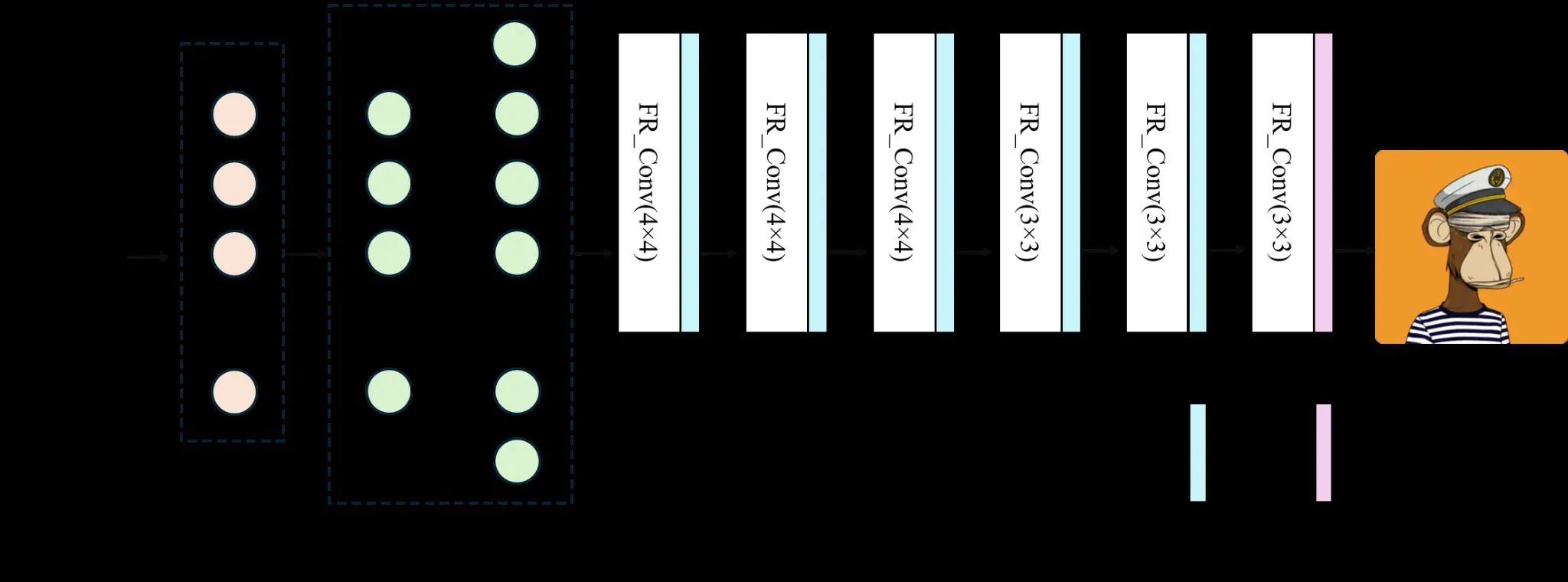
Dataset compression: a filename-to-embedding decoder regenerates the images.