

TallyMesh was presented at BCCA 2026 on 19 November 2026. It answers a simple question for open service markets: when clients call independent providers through a router, and no single party is trusted to keep the books, how does each provider get paid for every call?
Open service markets need a new kind of settlement
In an open service market, clients such as applications and AI agents send calls through a router to independent providers, and every call carries its own small charge. LLM APIs are the familiar example: a gateway routes each call to a model provider and bills for it. Today one platform owns the routing and the billing. As providers become independent inference nodes, the router becomes decentralized, and its settlement must be decentralized too.
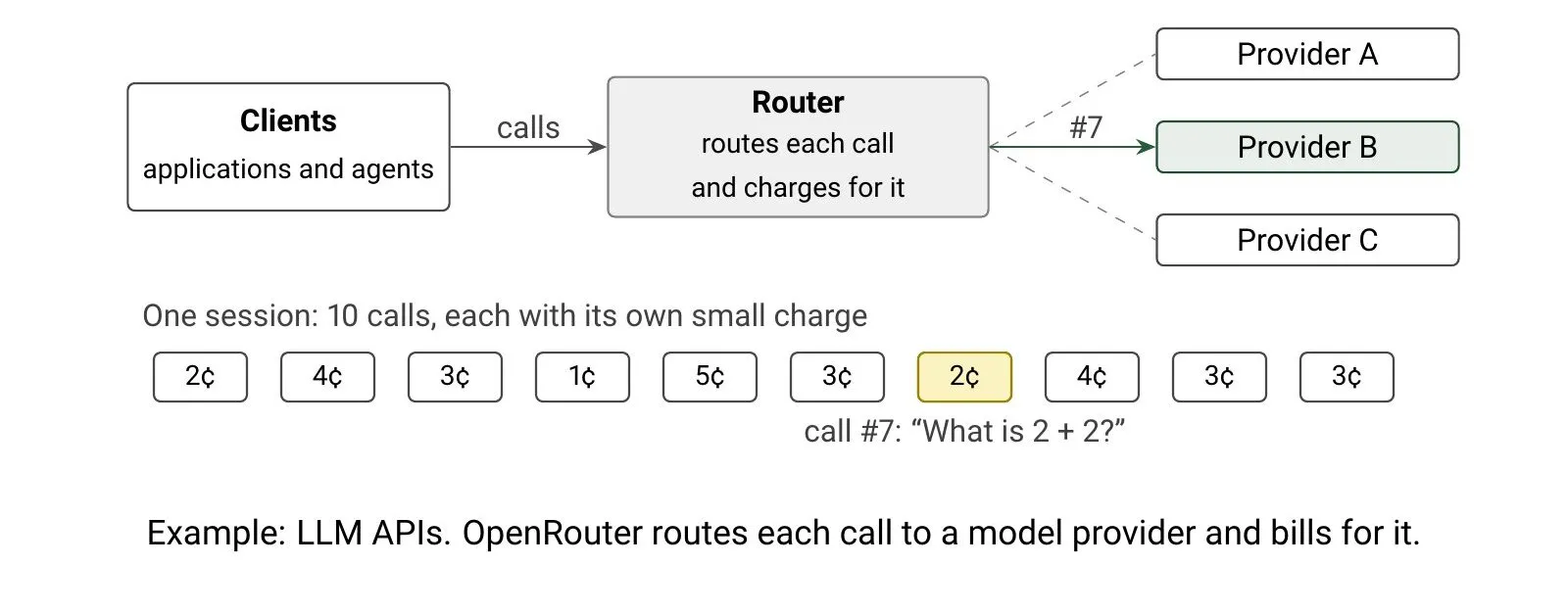
One session of ten calls, each with its own charge. Figure by the TallyMesh authors.
Settlement then has to prove four things on its own: the client sent the request, the provider answered it, each charge is owed and paid once, and neither side can cheat. Doing that on chain needs three properties: keep every receipt so any call can be audited later, share batch costs because a write per call costs more than the call, and choose when to finalize. Settling only the session total is cheap but loses the per-call record. Logging every receipt keeps the record but shares no cost. No existing system combines per-request receipts with batched, auditable settlement under a trust model chosen per batch.
The idea: the router routes, but no longer keeps the books
Every call produces a signed receipt, and receipts form a hash-linked transcript off chain. On chain, one batch root commits to all the receipts in a batch. Each batch then picks its own mode: optimistic for routine batches, which allows time to challenge, or a validity proof (ZK) for high-value batches, which is final on verification. Either way, one claim proof pays the whole batch.
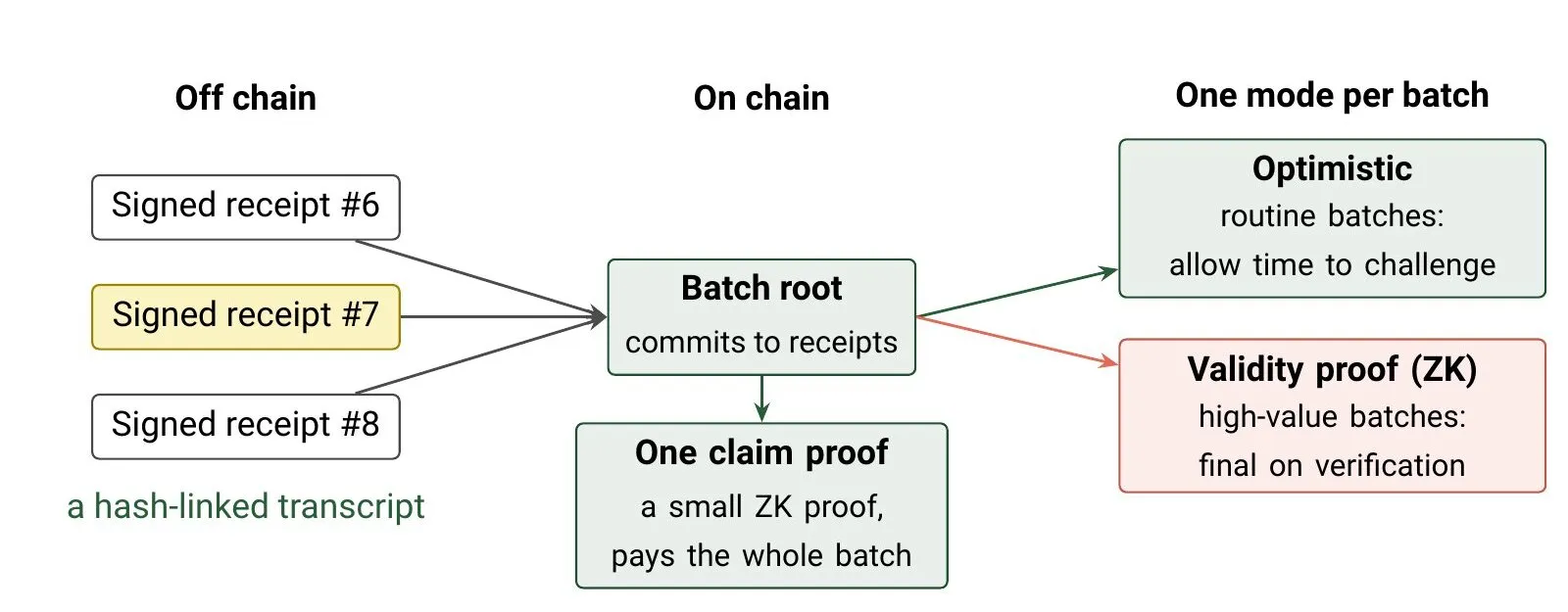
Signed receipts, one batch root, one mode per batch and one claim proof. Figure by the TallyMesh authors.
Signatures prove who asked and who answered, and security deposits make cheating costly. The client signs each request, the provider signs a receipt, and a submitter, which can be the provider, posts the batch root or proof. A watcher, the client or any validator, can challenge a bad batch.
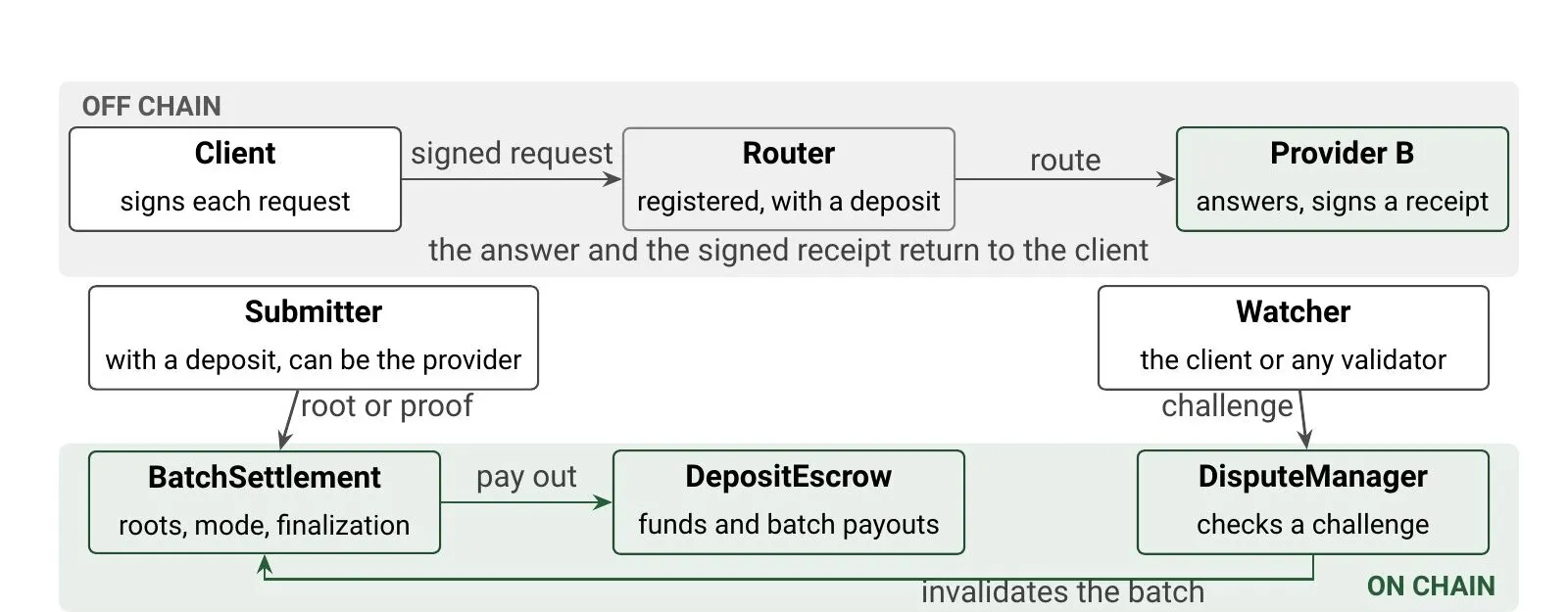
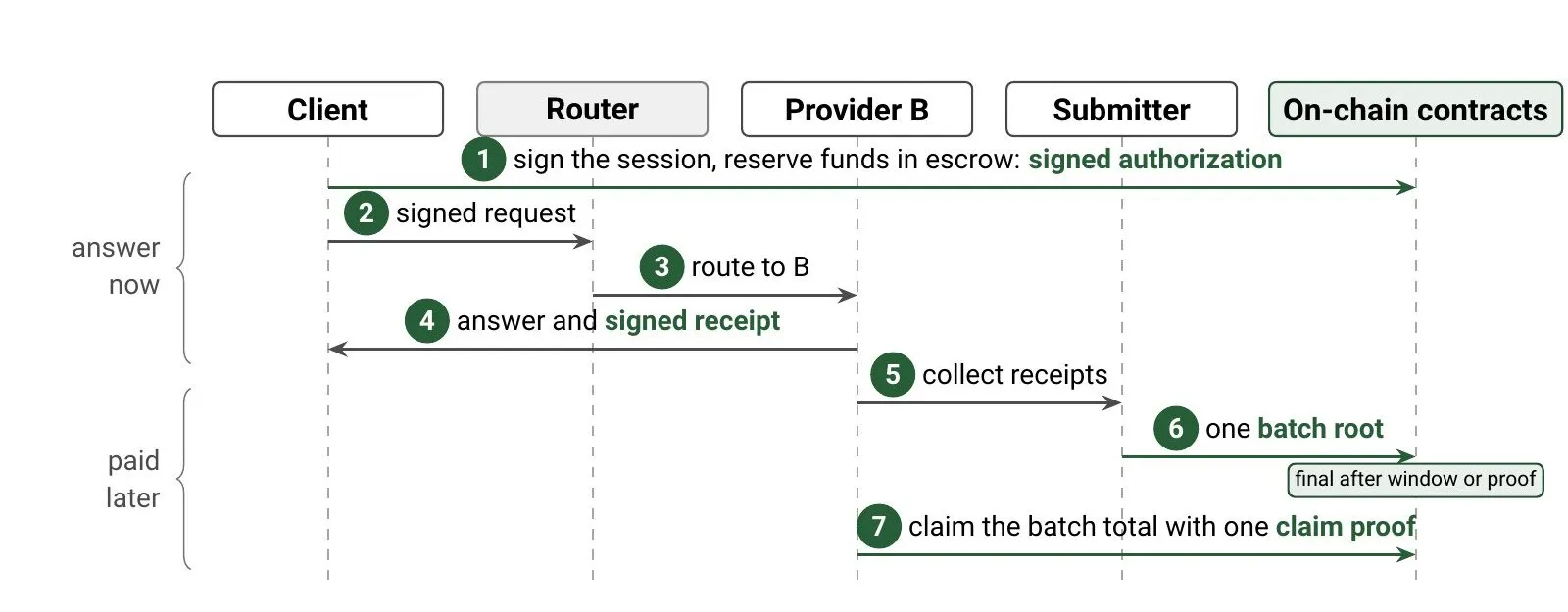
Who does what, and the path from one call to one payout. Figures by the TallyMesh authors.
Three key designs
One design for each call, one for each batch and one for each payout.
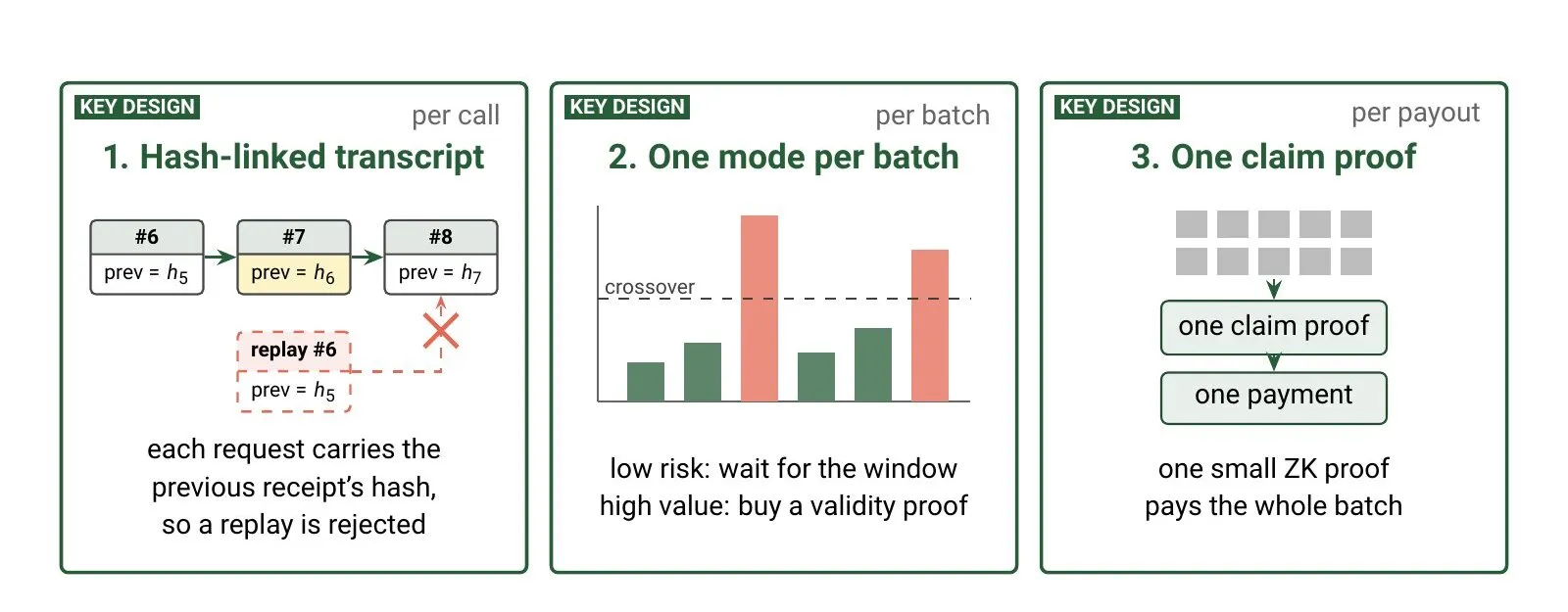
The three key designs. Figure by the TallyMesh authors.
1. A hash-linked transcript, per call
Each request carries the previous receipt’s hash, so a replayed call is rejected. Requests and receipts are EIP-712 typed data, and the batch root is a Keccak Merkle tree over the receipts. To check one charge, a watcher needs only that receipt and its sibling hashes, log2 N of them, which is enough to audit or challenge the charge on chain.
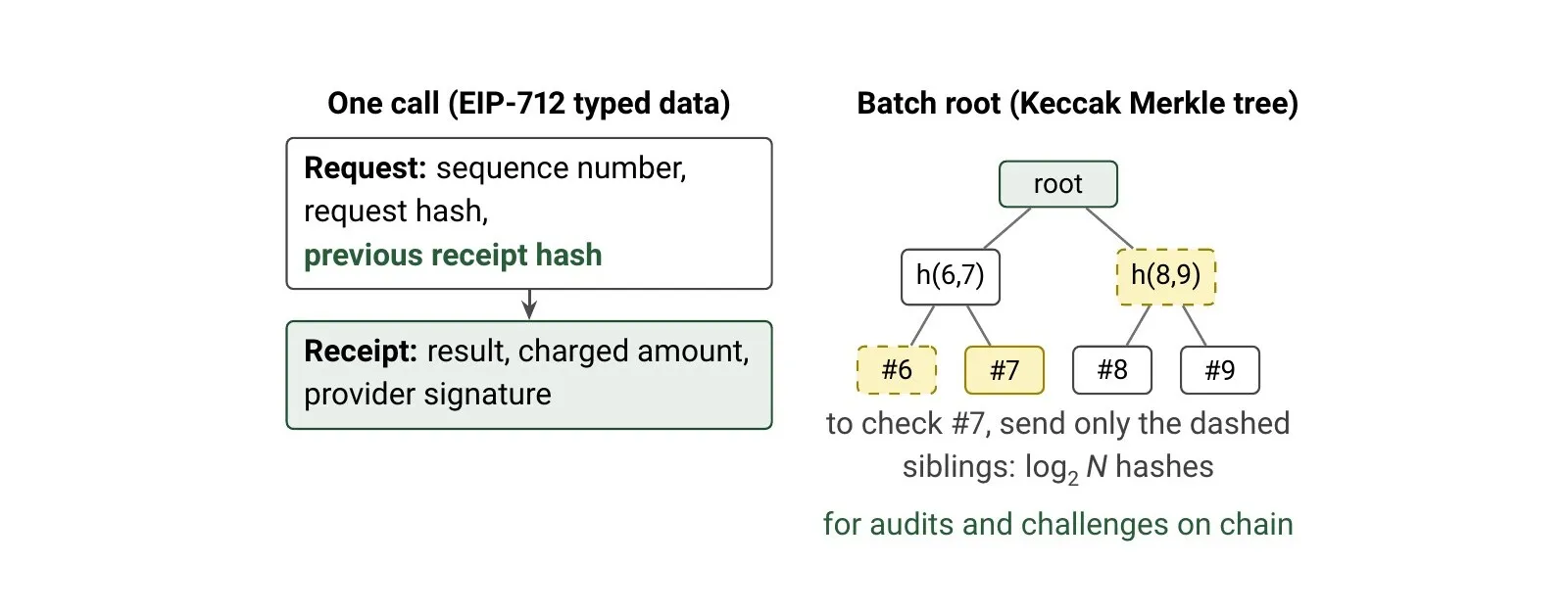
One call, and the batch root as a Merkle tree. Figure by the TallyMesh authors.
2. One mode per batch
An optimistic batch is final after a challenge window, 15 minutes for the LLM gateway case. If a watcher finds a bad receipt, the batch is cancelled and the submitter loses its deposit. Receipts go out as an EIP-4844 blob, retained for about 18 days on Ethereum, so the evidence outlives the window. A validity batch has no window: it is final once its proof is verified.
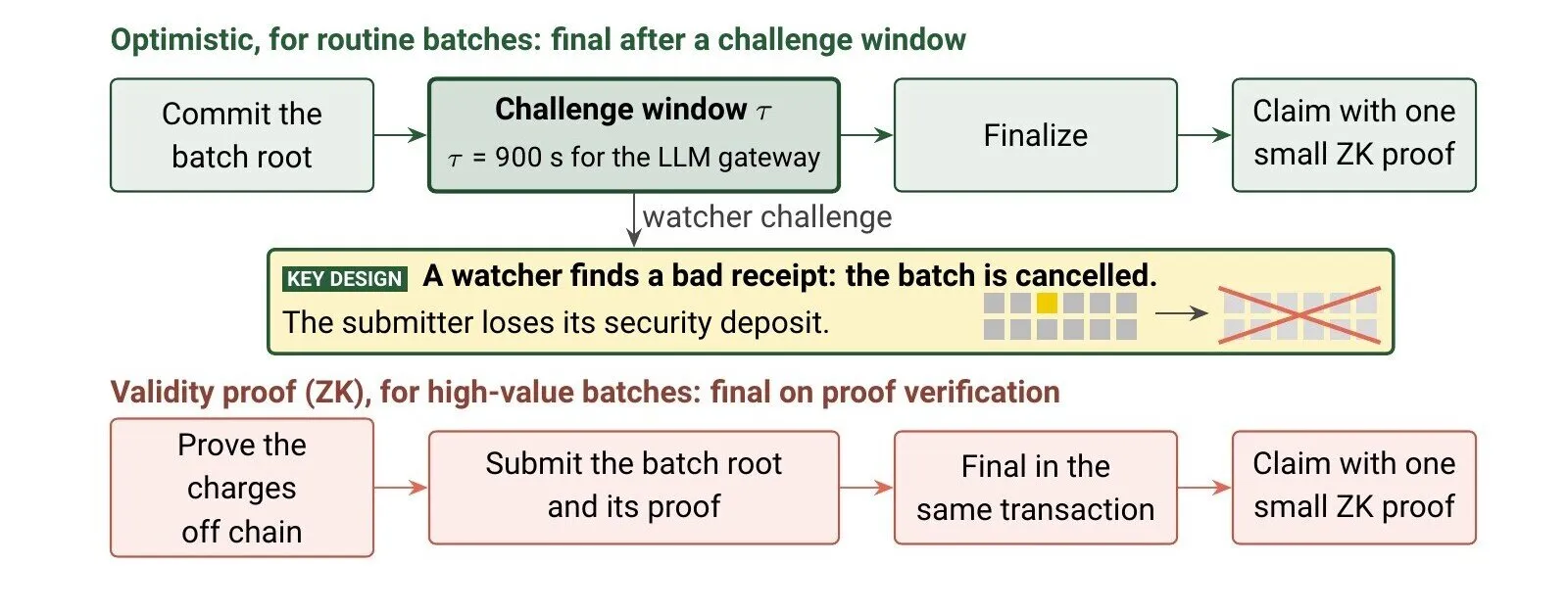
Two ways to admit a batch, one way to pay it. Figure by the TallyMesh authors.
Inside the validity proof, the submitter builds a Poseidon tree with one leaf per charge, up to 1,024 signed receipts, and a Groth16 circuit rebuilds the charge root and checks a fixed ceiling. The circuit has a fixed size, so it runs on an ordinary machine, and the contract checks the proof through an approved verifier in the same transaction.
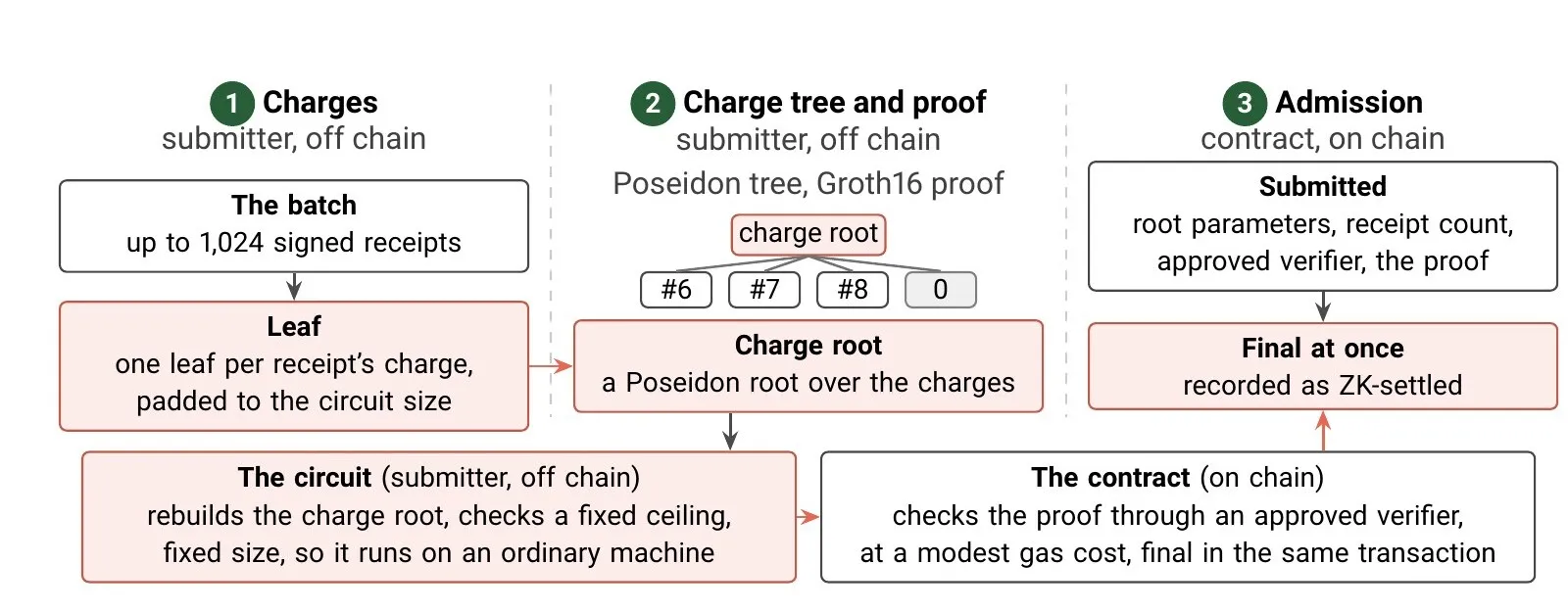
Inside the validity proof. Figure by the TallyMesh authors.
3. One claim proof, per payout
Payout is where the cost sits, because checking receipts one by one makes gas grow with every receipt. Instead, the provider proves off chain that the receipts add up to the total, and the contract verifies that proof once and pays once, while every receipt stays auditable.
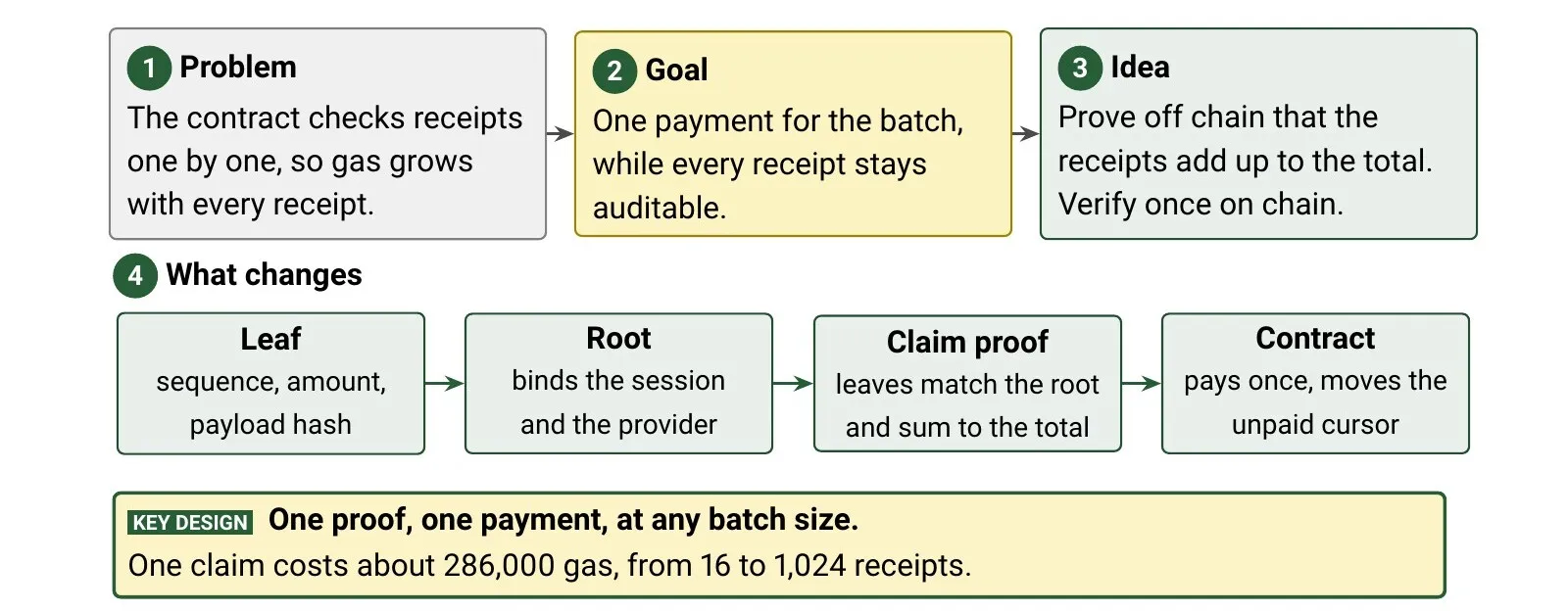
One proof pays the whole batch. Figure by the TallyMesh authors.
The claim uses a second Poseidon tree built from the same receipts. The circuit checks that amounts are 64-bit, the sequence is contiguous, the leaves rebuild the root and the amounts sum to the total. The contract checks that the root is final, the claim starts at the next unpaid receipt and the total is within the balance, then pays once and moves the unpaid cursor.
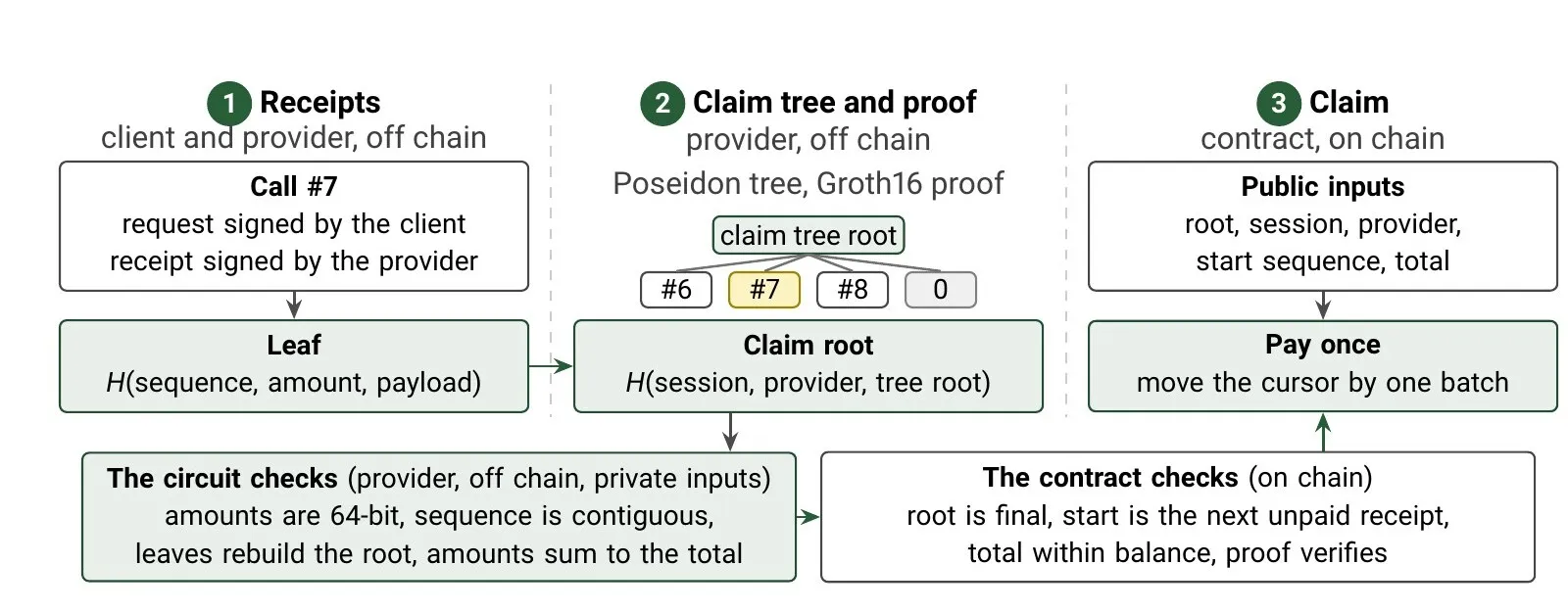
Inside the claim proof. Figure by the TallyMesh authors.
Results
Committing a batch is cheap. With 1,000 receipts in one optimistic batch, commitment costs 142 gas per receipt, about 470 times less than storing every request on chain at 66,355 gas per request. A validity-proof batch of 1,024 receipts costs 257 gas per receipt.
Payout stays flat. One claim costs about 286,000 gas at any batch size from 16 to 1,024 receipts. At 100 receipts, that is 286,352 gas against 3,444,970 when every receipt is checked one by one, about 12 times less. The claim proof takes from 17 ms for 16 receipts to 699 ms for 1,024.
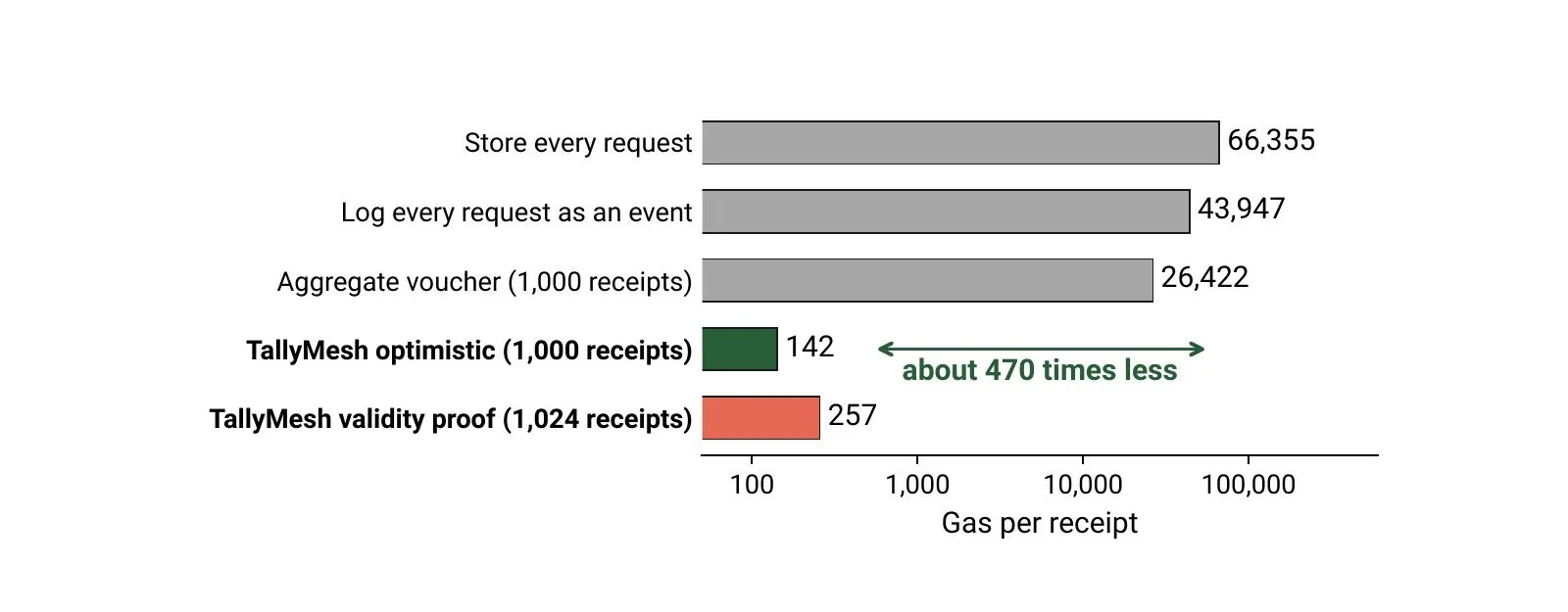
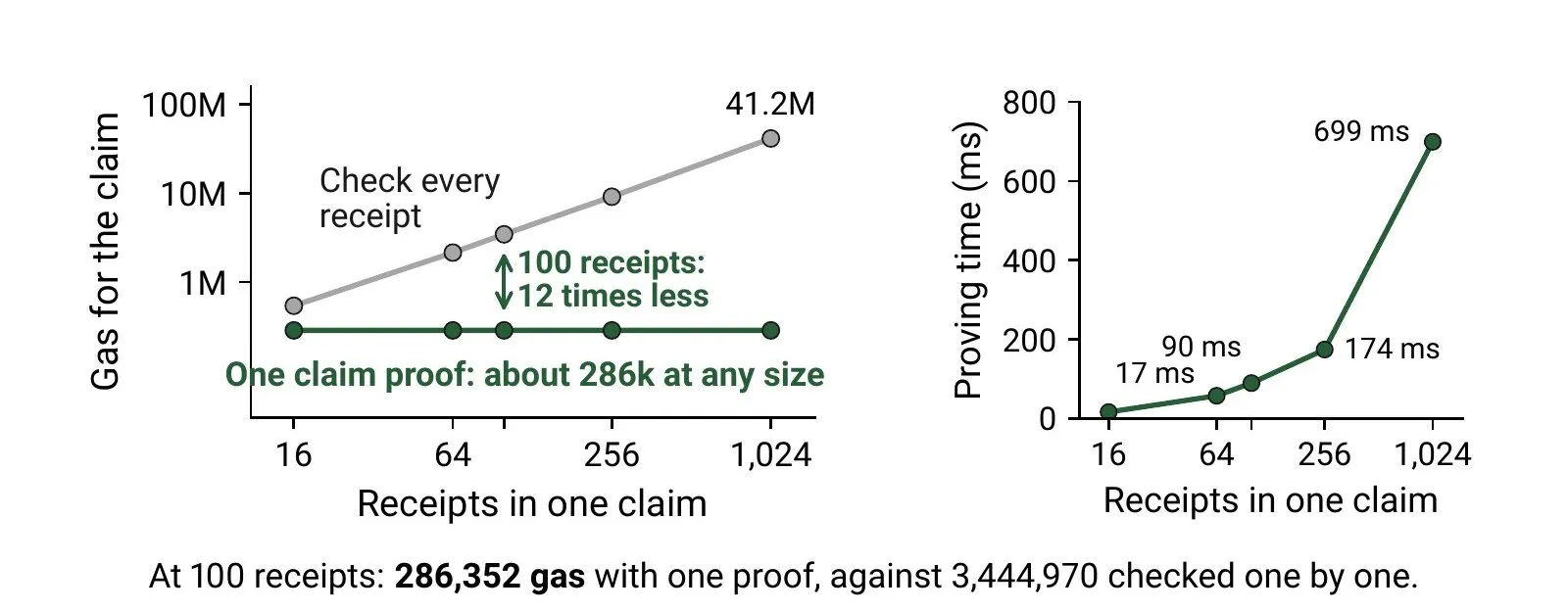
Commitment cost per receipt, and payout cost and proving time. Figures by the TallyMesh authors.
The mode is a choice per batch, by design. The expected cost of an optimistic batch grows with the money at risk, while a validity proof costs the same at any value and is final at once. So routine batches wait out the window, and high-value batches buy a proof.
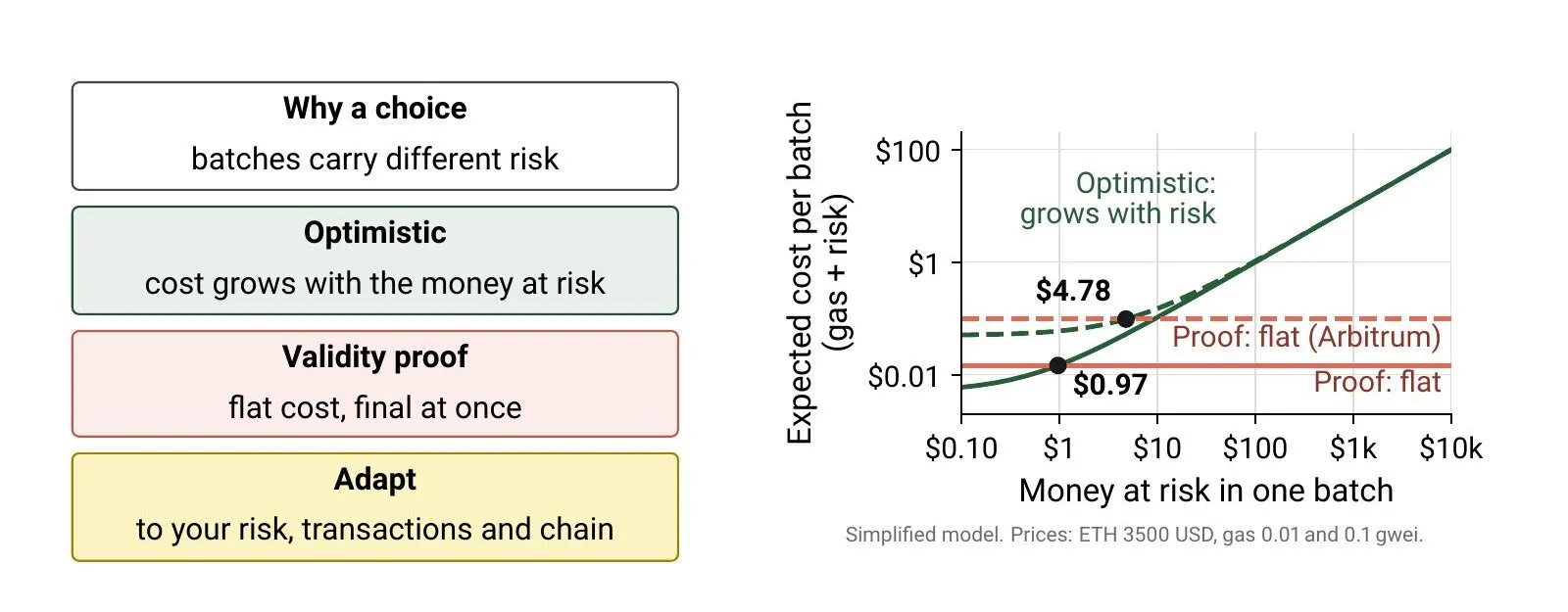
Choosing the mode by risk, in a simplified model with ETH at 3,500 USD and gas at 0.01 and 0.1 gwei. Figure by the TallyMesh authors.
What comes next
Next steps are risk scores that pick the mode from provider reputation, performance checks that judge answer quality, the same pipeline for more types of services such as validator networks, and real deployments that bind the claim proof to settled batches.