

Thermal and visible cameras fail in different ways. Thermal imagery keeps working in low illumination but struggles with look-alike backgrounds and occlusion; RGB brings abundant colors and textures backed by large training datasets, yet fades as light fails. Fusing the two modalities produces detectors more reliable than either sensor alone.
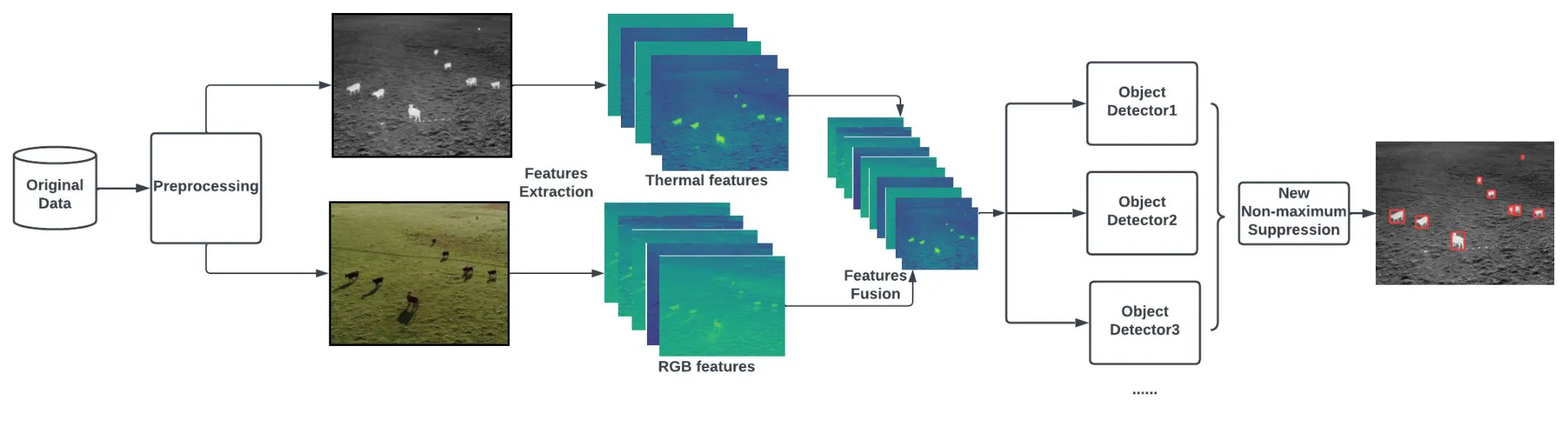
The fusion detection framework: feature extraction → feature fusion → detectors → NMS.
To test this, the group evaluates visible-infrared fusion for traffic and pedestrian detection on public benchmarks from two vantage points: the drone perspective (LLVIP, VisDrone) and the vehicle perspective (FLIR-aligned, M3FD, MAFD).
Across these datasets, its fusion variants are compared against four baselines: U2Fusion, SeaFusion, UMF and DetFusion. This work extends the group’s “from satellite to drone” perception line into everyday traffic scenes.
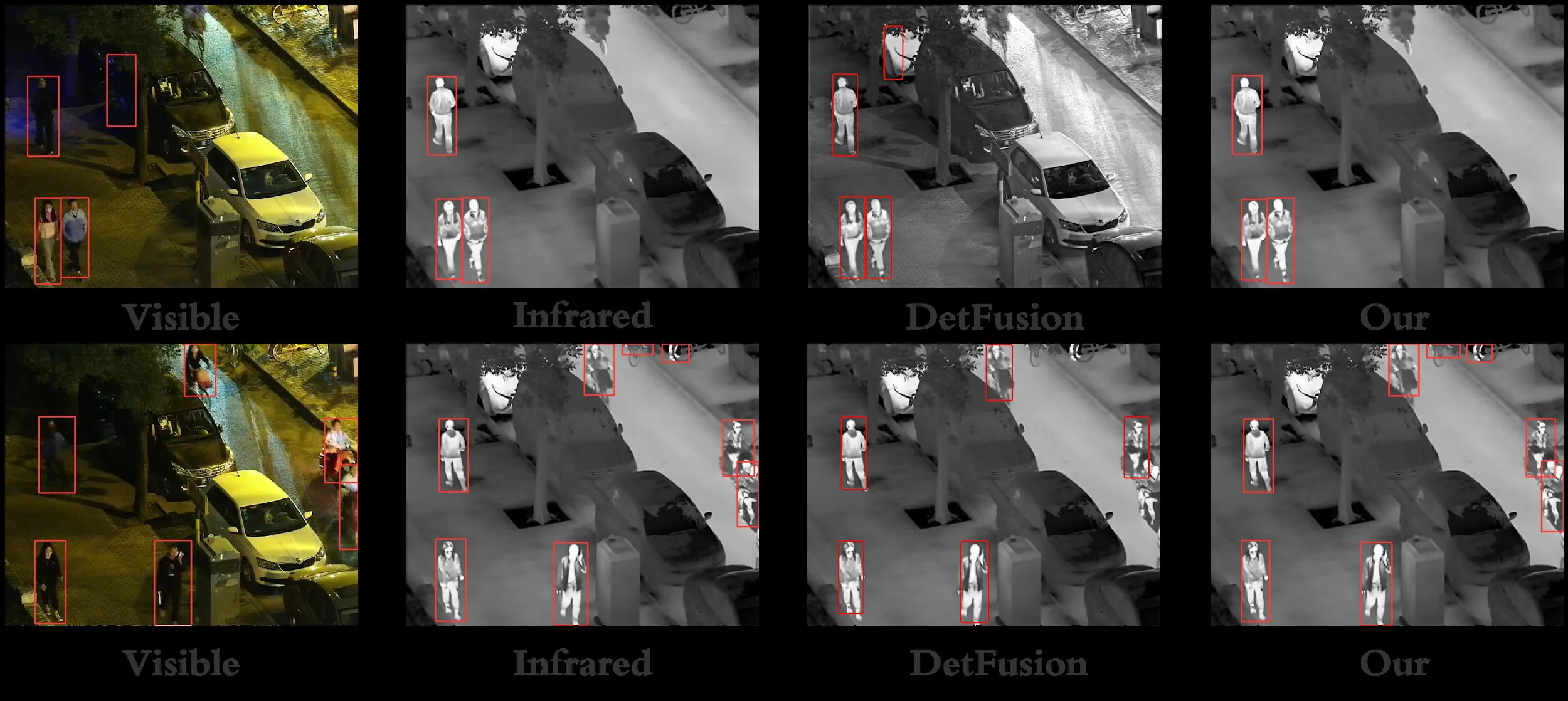
Pedestrian detection compared: visible, infrared, DetFusion and ours.